ERIC WHITE STUDIO
Fine Art in Detail


Fine Art in Detail
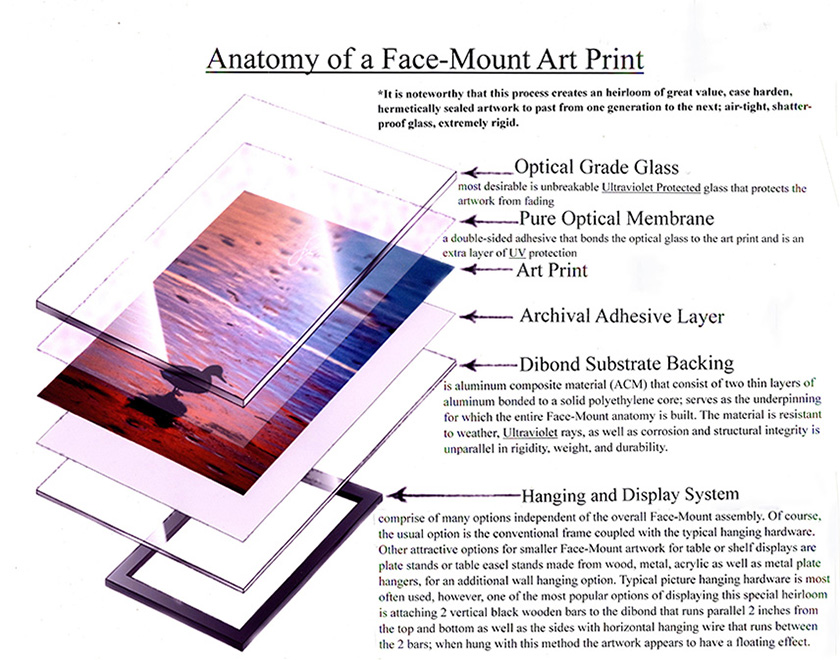
The Anatomy of a Face-Mount Print – FaceMount Enclosures brings the latest state of the technology to the world of preserving art prints. First of all, one of the most essential aspects to face-mounting artwork is printing on superior high grade photo paper or print media. Much emphasis must be placed on the procurement of high grade photo paper to print the artwork because most printmakers tend to use lower grade print paper to mitigate the expense of superior photo paper; the cost of the inferior quality print can be past on to the artist and ultimately to the buyer. The problem with printing artwork on cheap low quality paper is the high degradation factor, in otherwords the color fades rather quickly along with the paper yellowing; it could never be used in FaceMounts.
Acrylic Glass - Not all acrylic glass is alike. Specifically, there is a choice between cell cast acrylic and extruded acrylic. Cell cast acrylic glass is harder, has a more uniform thickness, is more scratch-resistant and is typically clearer than extruded acrylic. Eric White Studio like most people in the industry only use cell cast acrylic for face-mounting and UV reduction, regardless of the thickness and cost. In fact, cheap plexiglass is predominately used by people printing photos on glass; that process is nothing remotely close to (The Anatomy of FaceMount Prints) mostly because there is no art print involved, only ink printed on the back of cheap plexiglass with a thin white core backer.
Facemount with special adhesive sheets The third essential aspect to face-mounts is an optically clear mounting adhesive, a two-sided adhesive that is used to adhere the artwork to the acrylic glass. It’s imperative that this is of the highest quality to ensure a very clear picture with no distortion. The first adhesive sheet acts as an ultra-violet reducing membrane and is engineered for the face-mounting of virtually any image to clear substrates like acrylic and polycarbonates, which means that it is a fantastic option for high-quality photographic and inkjet printed images and the 2nd adhesvie layer is designed to permanently bond the print and upper layers to the backer.
The Backing - The backing must support the weight of the acrylic glass without tearing away from the back of the artwork to which it is adhered, and also maintain its adhesion to the mounting hardware. For wall-hung pictures, Dibond backing or coloured 1/8″ cast acrylic sheet is typically used, however, Eric White Studio always use 1/4" for additional rigidity. Dibond is basically an Al sandwich: a composite that consists of a high-strength aluminium skin on both sides, sandwiching a super-strong polyethylene centre core. It provides the utmost protection to the back of your picture while providing an incredibly strong substrate from which your acrylic glass can safely hang.
Hanging Systems No matter how good your backing is, if your hanging system fails, then everything else ceases to matter. It should be strong enough to support the weight of the material, for if the weight exceeds the stability of the hanging hardware to hold, failure will be emminate therefore cleats are not recommended. In a hanging system one must use their own discretion; typical frames have rabbet channels that will recess the artwork where 3/4" of the image could be lost around the perimeter of the facemount print.
An alternatively is a standoff style hanging systems, they're essentially metal bolts that hold an image to the wall with anchors installed into the wall surface. One must drill 4 holes through the facemount enclosure as well as in the wall; not recommended for art greatly reduces the print value, perhaps best for posters and other photographics. We recommend using plate hangers, they're now made with sufficient strength to hold the weight of the facemount enclosure and allows the artwork to protrude from the wall and the fixture will be unseen while displaying the entire image with a hassle-free way to hang the work.
Remember our facemount enclosures have 3 layers of UV protection to prevent the print from discoloration or fading
Our facemounts also have Optical Grade Unbreakable Glass with hermetically sealed (airtight) enclosures; all scratches are quite easily removed with a very fine sandpaper; rated life is designed to last for many generations.
If you have any questions about Facemount Enclosures please text me at 1-865-283-6588 for the quickest response